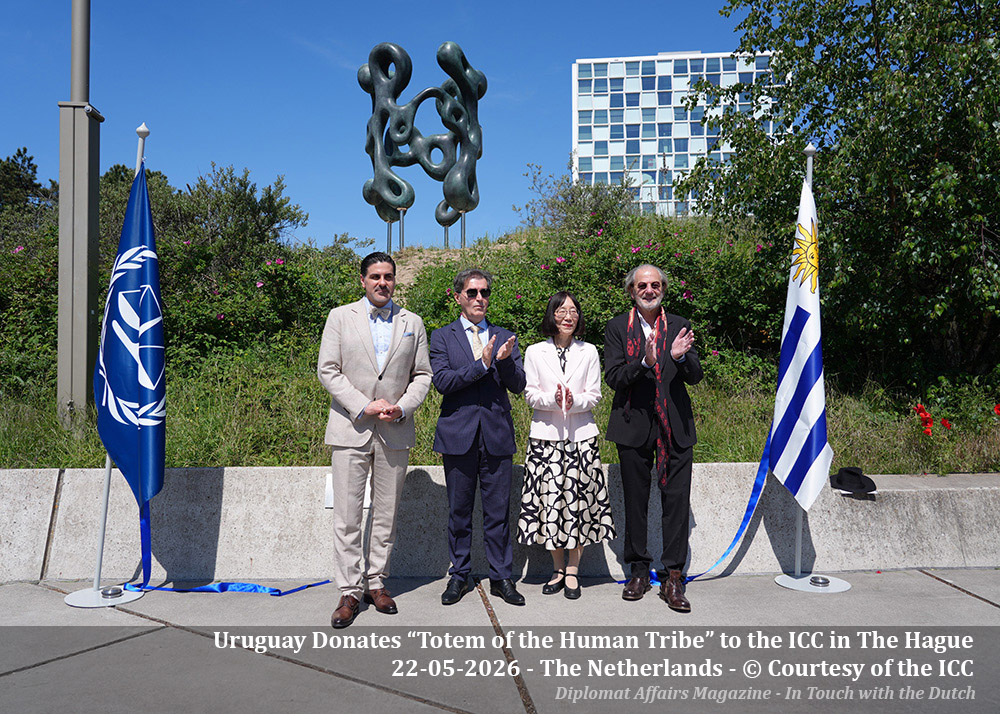
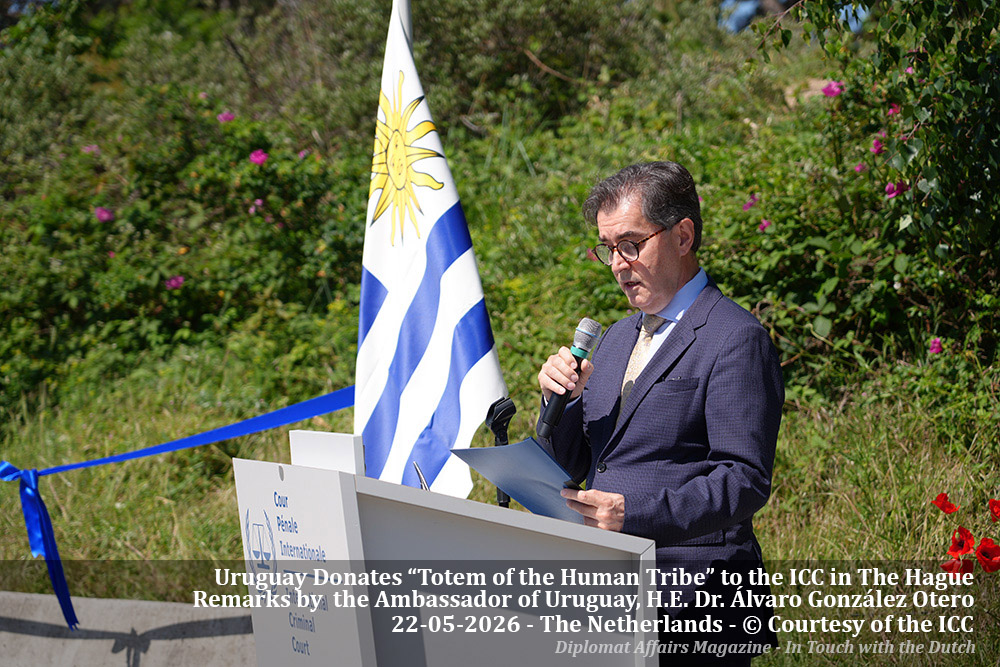
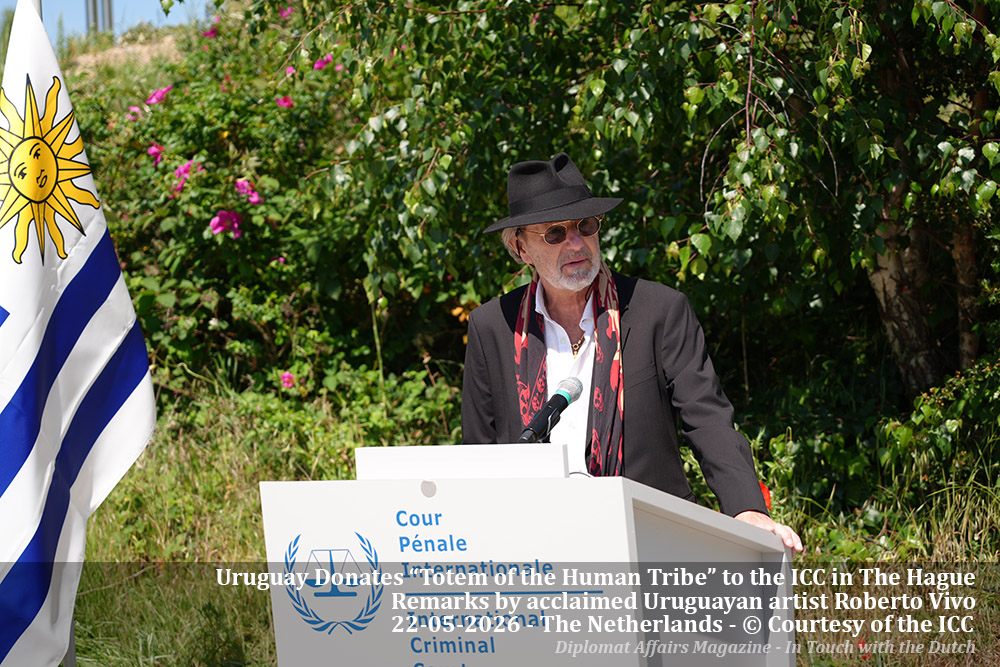
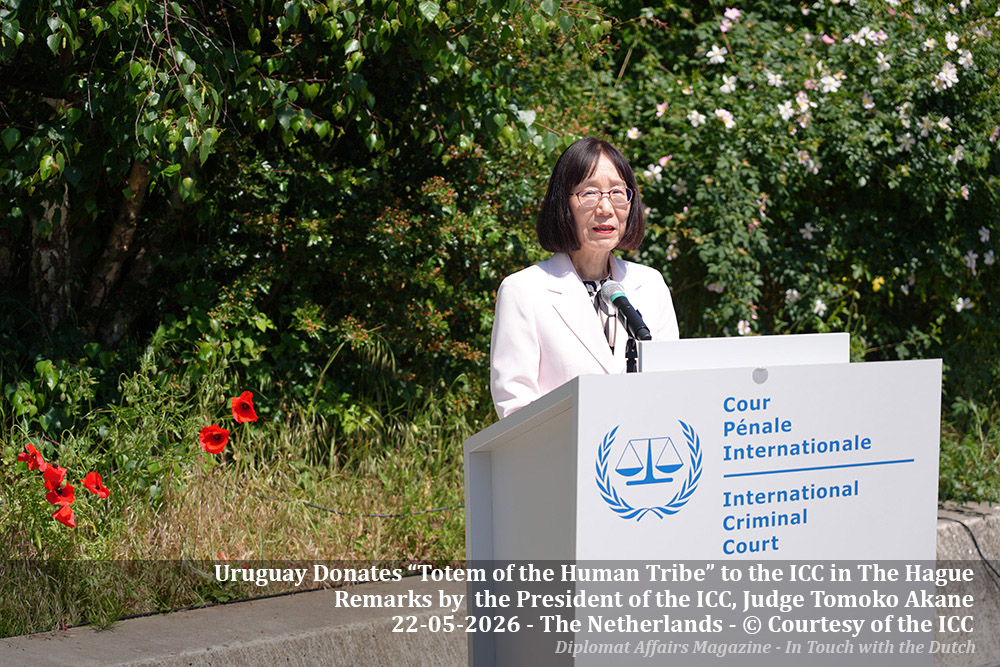
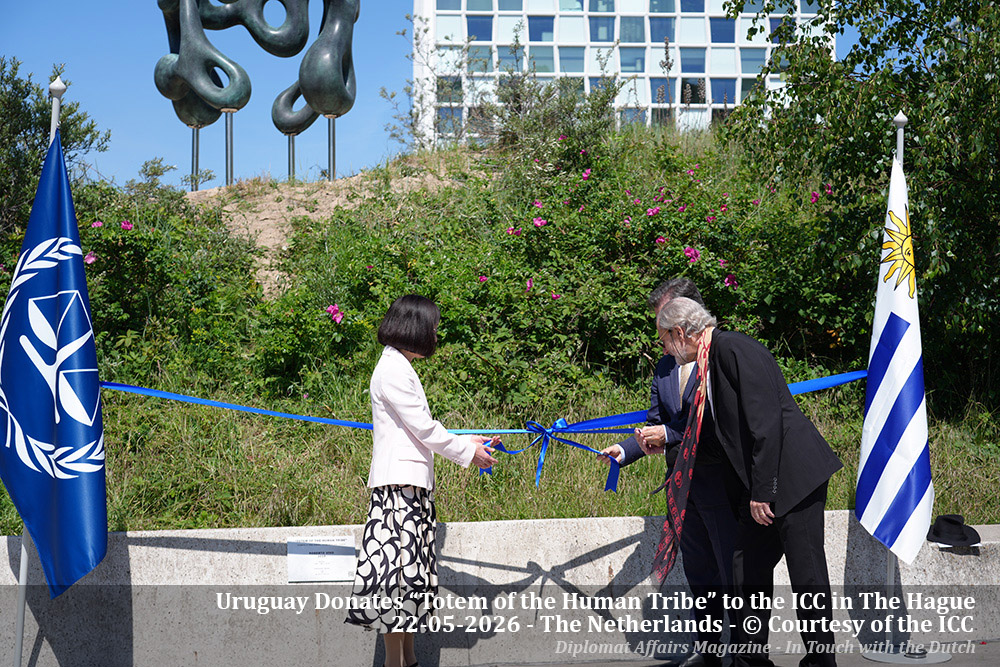
From left to right: the Registrar of the Court, Mr. Osvaldo Zavala Giler; the Ambassador of Uruguay, H.E. Dr. Álvaro González Otero; the artist, Mr. Roberto Vivo and the President of the International Criminal Court, Judge Tomoko Akane
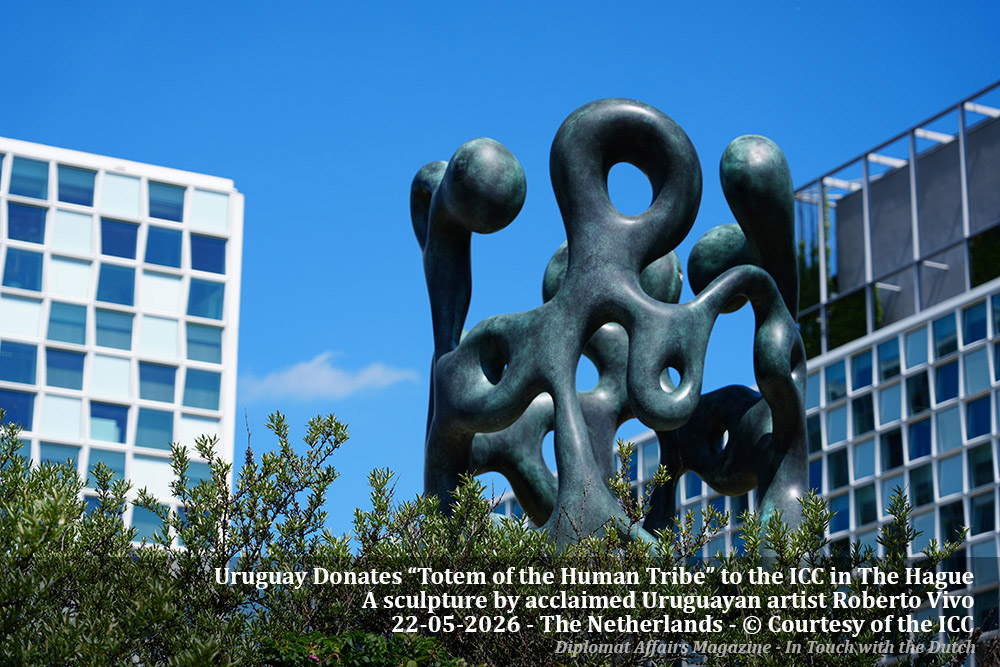
An impressive new symbol of peace has been donated to the International Criminal Court in The Hague, the Netherlands.
On 22 May 2026, the unveiling ceremony of the sculpture “Totem of the Human Tribe” took place. The piece was donated by the Uruguayan State to the International Criminal Court (ICC) as a symbol of peace, coexistence, and respect for International Law.
The event brought together many Ambassadors and representatives of ICC States Parties, as well as local authorities, judges, officials from international organizations, and members of the Uruguayan community residing in the country.
The large attendance reflected the interest in, and symbolic value attributed to, this work of art, conceived as a reminder of Uruguay’s commitment to peace and international justice.
Among the distinguished guests who honored the ceremony with their presence were the former President of the Assembly of States Parties, Ms. Silvia Fernández de Gurméndez; writer and former ICC Prosecutor, Mr. Luis Moreno Ocampo; the Registrar of the International Criminal Court, Mr. Osvaldo Zavala Giler; and the President of the ICC, Judge Tomoko Akane. Their attendance underscored the institutional relevance of the event and the recognition of Uruguay’s cultural contribution.
Donation of books to the Court
Prior to the start of the ceremony, the Registrar received H.E. Dr. Álvaro Enrique González Otero, Uruguay’s Ambassador to the Kingdom of the Netherlands and the artist, Mr. Roberto Vivo.
On that occasion, Mr. Vivo made a symbolic donation of books authored by him, which will become part of the Court’s institutional library.
This gesture was particularly appreciated by the authorities, as it strengthens the cultural and academic ties between Uruguay and the ICC.
During the ceremony, Ambassador González Otero opened the program by reading a letter sent by the President of the Republic, H.E. Mr. Yamandú Orsi, prepared especially for this occasion.
In his message, President Orsi emphasized that the donation represents a “source of national pride” and a powerful amplifier of a message of peace that is urgently needed in today’s international context.
Ambassador, H.E. Dr. Álvaro Enrique González Otero then delivered remarks highlighting Uruguay’s longstanding tradition of support for the International Criminal Court, which he described as an indispensable tool for justice and accountability. He also underscored the role of art as a universal language capable of transcending borders, languages, and generations, inviting us to reflect on shared values.
Next, the artist and creator of the work, Mr. Roberto Vivo, offered a brief presentation on the inspiration behind the Totem of the Human Tribe. He explained that the piece seeks to convey the idea that, beyond cultural, geographical, or political differences, humanity shares a common origin and an interdependent destiny. The verticality of the totem symbolizes the continuity of human history and the collective responsibility to build a future rooted in peace.
Following this, the President of the International Criminal Court, Judge Tomoko Akane, delivered a speech in which she expressed her gratitude to Uruguay for this meaningful donation, highlighting its profound symbolic value and its contribution to the cultural heritage of the institution.
The highlight of the ceremony was the unveiling of the sculpture. As the veil was lifted, the audience responded with prolonged applause, acknowledging both the artistic value of the work and the strength of the message it embodies.
The installation of this sculpture thus stands as a significant contribution by Uruguay to the cultural and symbolic heritage of the International Criminal Court, and as a permanent reminder of the commitment to the values that unite humanity.